Disclosure: This post contains affiliate links. We may earn a commission at no extra cost to you.
If you’re wondering whether the Whoop band can be worn on the ankle instead of the traditional wrist placement, you’ve come to the right place.
In this post, I’ll explore the feasibility of wearing the Whoop on the ankle and cover the placements Whoop actually validates for accuracy.
The short answer: Whoop can physically be strapped to the ankle, but Whoop does not recommend or validate it. The officially supported placements are the wrist, the bicep (via the bicep band), and — on the Whoop 5.0 and Whoop MG with Any-Wear™ Technology — the torso, waist, and leg using Whoop Body garments. If you want the sensor off your wrist, those are the accurate options.
Table of Contents
What is Whoop?
The Whoop is a high-tech wearable that measures workout intensity, sleep, and how you recover from workouts and gives tips to improve in these areas. The current generation is the Whoop 5.0 (and medical-grade Whoop MG), which replaced the Whoop 4.0 in May 2025 — see our Whoop 5.0 vs 4.0 comparison. Whoop depends on heart rate, HRV, and other important metrics to assess workout strain, sleep quality. This wearable doesn’t have a display since it’s not designed as a regular watch or an extension to your phone.
What Does It Do?
The Whoop app has three categories: sleep, recovery, and strain.
Sleep
The Whoop analyzes the duration of your sleep, the sleep stages, and how restful your sleep is. It also comes with a Sleep Coach that suggests how long you should sleep, depending on your training schedule the next day or how you want to feel.
Recovery
Recovery measures how your body is ready to respond to a training stimulus or how your body will respond to strain. Whoop shows you when the RHR, sleep quality, or HRV, or sleep quality declines, meaning that you need to take a rest or slow down on your workouts.
Whoop gives you a daily recovery score based on your sleep quality, your activities the previous day, and other aspects like resting heart rate and HRV.
Strain
The amount of energy you use in workouts can show how strenuous your workouts are and how your body responds to travel, work, and stress. Whoop recommends that the amount of strain you use every day should be related to your recovery the previous night.
Related: Best Whoop Band Alternative
Key Features of the Whoop
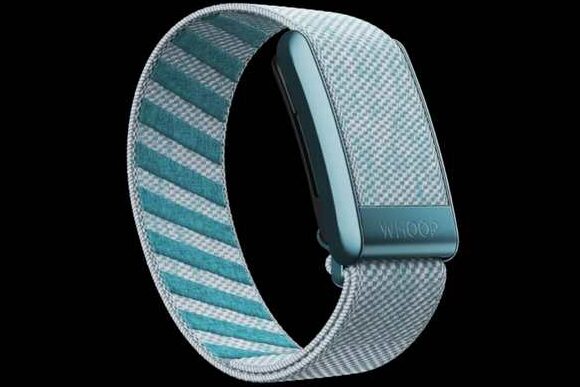
Don’t be fooled by Whoop’s simplicity; it comes with a ton of sophisticated sensors that can measure your heart rate variability (HRV), heartbeats per minute, 3D acceleration, skin temperature, and movement. These sensors include:
- Optical Heart Rate Sensor: This sensor measures your heart rate and heart rate viability using green LEDs that shine light through your skin and four photodiodes that collect the reflected light.
- Pulse Oximeter: The Whoop uses this sensor to track your spO2 (blood oxygen saturation) using one infrared LED and one red. This sensor is also used for sleep tracking.
- Skin Conductance Sensor: This sensor keeps tabs on how your skin conducts electricity and the changes that occur. This is a critical aspect because it improves the reliability of sleep tracking.
- 3D Accelerometer and Gyroscope: The built-in accelerometer is used for exercise tracing and workout detection. Whoop uses an accelerometer to help with heart rate monitoring and check your respiration rate while asleep.
Related: Whoop vs Garmin Fenix 6
Where should I wear my WHOOP Strap?
The Whoop strap is designed to be worn on your wrist, about a finger’s width above the wrist bone, snug enough that it doesn’t slide. If you want it off your wrist, Whoop officially supports two routes:
- The bicep band — an official Whoop accessory worn at mid-bicep with the sensors against the skin. Great for lifting, contact sports, and anyone whose wrist placement gets knocked around.
- Whoop Body garments with Any-Wear™ Technology — on the Whoop 5.0 and Whoop MG, the sensor pod slots into pockets in Whoop’s apparel line, and Whoop has validated accuracy at the wrist, arm, torso, waist, and leg placements.
So, Can Whoop be worn on the ankle?
Not officially. The ankle is not one of Whoop’s validated placements — no version of the strap or Whoop Body apparel is certified for ankle accuracy. People do strap Whoop to their ankle (nurses and athletes with wrist restrictions, for example), and the sensor will still record, but heart-rate and HRV readings there aren’t guaranteed to be accurate, and features that depend on precise HR data (strain, recovery, sleep staging) can drift.
If your job or sport rules out wrist wear, the validated alternatives are the bicep band or, on the Whoop 5.0/MG, a leg placement via Whoop Body compression shorts or boxers — the closest officially supported spot to the ankle.
Related: Whoop Band 4.0 Review
Can you wear a Whoop Strap on the bicep?
Absolutely! You can use a bicep band to help you move the Whoop Strap off your wrist. This is an excellent option if you prefer wearing your device on your biceps.
Related: Whoop or Apple Watch?
FAQs
Does it matter which wrist you wear whoop?
It doesn’t matter which wrist you wear your Whoop Strap. However, you should ensure that your Whoop is snug but not too tight. Ensure that the sensors have solid contact with your skin.
Should I wear my Whoop strap all the time?
Yes. The Whoop is designed for 24/7 use. Therefore, it’s important to put on your Whoop for accurate sleep and recovery data.
Can You Shower With a Whoop?
Yes. After a shower, remove the strap and wash the band with water/soap. Also, wash the area of your skin covered by the strap sensor.
Can I Wear Whoop on Dominant Hand?
You should wear your Whoop strap with the right tightness on the non-dominant hand. Your device should lie two fingers-width above your wrist bone.
Final Thoughts
If you engage in intense workouts, you need to place your Whoop in a spot that gives both stability and accurate readings — and the ankle isn’t one Whoop validates.
Stick to the wrist for everyday wear, grab the bicep band for contact sports and lifting, or use Whoop Body garments (Whoop 5.0/MG) for torso, waist, or leg placement. If ankle wear is truly your only option, know that your data may be less reliable there.
I hope I have satisfactorily answered the question “Can I wear Whoop on my ankle?” If you’re still shopping around, our best ankle fitness trackers guide covers devices actually designed for ankle wear.